Wednesday, 17 July 2013

Plagas Department


We’ve started our rotation in the Plagas department, where we are learning how to fight pesticides using natural predators. Norma and Roxana head this small department of four. Two men also work in the department and are responsible for spraying the plants with natural pest repellents, but I have yet to meet them. Also working closely with us is Nelly. Nelly is in charge of a natural protected area close to the organopónico so she sets up office with the women in the Plagas department. I haven’t gotten a chance yet to ask her exactly what she does but I will soon!
Norma and Nelly are pictured below (Roxana was away for the day)

Nelly on the left, and Norma on the Right
Our days in the plagas department start with an hour of caracol (snail) hunting back out in the fields with Alexi, Pedro, Marie Sol and all the guys in the Hortilizas department. Most days we're joined by Elsa and Mabel from the casa de posturas and it's always nice to talk with them again. It’s amazing all the tiny bugs you can find in the top inch of soil in the garden beds. Yes, there are hundreds of snails, but there are also crickets, ants, millipedes, potato bugs and spiders (thankfully they are fairly small). 
After this, we have been shadowing Norma around the farm. Norma is the most enthusiastic teacher I have encountered yet on the farm. She seems genuinely excited to try and cram as much information about her department into our heads over the few weeks she has us. She’s already begun to plan out activities for us so we can better understand the processes they use to control the pests. She adamantly expressed however, the changing nature of their job. One year the pests might ‘magically’ be gone, or present at such a low level that they’re not a worry. Other times, like this summer with the snails, the pest levels can be so high that entire crops are destroyed days after they are planted. She also added that they never want to completely eradicate a pest since without a pest present in the fields, there won’t be any natural predators either. In short, the good bugs go where the bad bugs are, so to have the good you have to have the bad as well.

The small office for this department is filled with natural extracts from many different plants including tobacco plants, and nim trees which can be watered down and used as natural pesticides, and on the far wall there are books on medicinal plants, toxic plants and of course insects. A poster on the wall shows pests and their corresponding predators, and beneath it on a small table are two microscopes that Norma and Roxana use to identify the various insects they collect from the field.

Today, unfortunately as Kat wasn’t feeling well I went to work alone, but I was quickly joined by three other students. Together, Cecilia from Colombia, Pamela from Mexico and Mateo from France, Roxana and I went around the farm collecting ladybugs and as many aphids as we could from the mint and green bean plants. Ladybugs eat 100 aphids a day, and their larvae can eat between 200 and 300 a day, so in order to sustain our captured ladybugs we had to find a lot of aphids. We then placed the ladybugs and aphids in the department’s containers, and I assume soon we’ll be refilling these containers with new aphids.

This department is going to be quite information intensive, so over the next two weeks or so I’m going to take it all in before posting again. Below are some of the photos I’ve got from the department so far.

The entrance to the department. Roughly translates to: Laboratory for breeding beneficial insects.

Norma shows us how the corn stalks surrounding the fields attract pests away from the crops.
A container used to breed natural pests
In other news, this past week my family came to visit! It was incredible to get to see them for a while, to take advantage of the buffet breakfasts at the hotel, and to play tour guide for a week. I miss them already!

Here are my beautiful parents in Viñales. Mary on the left, Bill on the right. Happy early anniversary!!
Daniel and I in Viñales

A little unrelated, but this is a gorgeous sunset we saw from the Malecon
Daniel, Mom & Dad in Viñales
My Cuban Family (missing Dacio) and my Canadian Family
From left to right: Chino, Bill, Lily, Mary, Daniel


Sunday, 7 July 2013

Viñales!!


Kat, Kat's mother and brother, Sue and Chris, and I spent the past weekend in Viñales. Easily one of the most beautiful places I have visited in Cuba, Viñales is a small town west of Havana in the province of Pinar del Río. I would have to recommend this town to geology lovers in particular. While my knowledge of geology is limited, I can tell you that the beautiful mountains in Viñales are called "Limestone Karsts" and can also be found throughout Asia.  The woman we were staying with, Mirtha, set us up with one of her friends who took us on a walking tour of the countryside. He led us through farmers' fields, over and under barbed wire fences, and all the while we got an excellent view of mountains and tobacco fields.  Due to the recent rain, our walk quickly became muddy but once your feet are covered in mud you stop worrying about getting dirty and just enjoy the squishy sensation.

We toured tobacco fields and learned a little about the cultivation process. After spending three months growing in the fields, the tobacco leaves are hung in the drying houses for another three months. It's obligatory for the farmers to then sell 90% of their crop to the state and the remaining 10% they cure and roll themselves to sell to the public. To cure the tobacco each farmer combines the leaves with his own particular mixture of water, rum, honey, pineapple, guava and other fruits to add flavor. The way they cure the tobacco diminishes the amount of nicotine in the cigars. The majority of the nicotine in the plant is actually contained within the stems which are not used in the cigars but are instead are used as a natural pesticide.  One of the most photogenic farmers, Orestes (who said he was named after Saint Orestes) gave us a quick demonstration of how the cigars are hand rolled. Orestes and his son offered us coconuts filled with coconut water, rum and honey, which we drank together in a small cabin on top of a hill. During our time with Orestes and his son, a storm rolled in and we were happily trapped there for close to an hour. Some farmers from nearby fields came round to take shelter, while one rode off on his horse to get a bottle of rum. He came trotting back shortly and we all shared a couple more drinks before heading back home along the muddy path.

Here are a couple photos from our walk:


A tobacco drying house 
A bull and the approaching storm
Tiny tobacco seeds
I kind of fell in love with this little guy. 
Just a little muddy

Crawling under barbed wire

Kat and I

Kat, Chris and Sue

Our delicious coconut drinks

Orestes - the most photogenic farmer ever.

After the storm

Our walk home.

We're back in Havana now and since Kat's birthday was yesterday our Cuban Madre, Lily, has prepared a surprise for dinner! Tomorrow Sue and Chris are headed to the airport early in the morn, and Kat and I go back to work. This week my family is visiting so in all likelihood I won't post again until next week.
Hasta luego! 

Thursday, 4 July 2013

Hortalizas

We've moved into "el campo" (the field) or the department of Hortalizas (vegetables) where we'll be working for two weeks. Hortalizas is by far the largest department and is where all the seedlings from the casa de postures go to be planted in the long "canteros" (raised garden beds). To give an idea of their size, 1000 plants can be planted in one cantero. The size of this department demands for more workers. Thirteen men and one woman keep this department moving. They rotate between planting the seedlings, and harvesting them when they're ready to be bundled and sold. Alexi (who I found out today is married to Luisa who works in Agroindustria) and Pedro pictured together below have largely taken Kat and I under their wing. The two often sing together while working and are by far the most talkative of the group. 

Alexi and Pedro (Pedro's holding the strips of fabric used to tie up bundles of lettuce/chard)
The past couple days we've been planting lettuce seedlings. They spend a month in the casa de postures before coming out to the field to be planted where they mature for another month. The bundles of chard and lettuce pictured below both sell for 4 cuban pesos a piece. 

Bundles of Chard - 4 Cuban pesos a piece
Lettuce before being tied - also 4 Cuban pesos a piece
In this department the irrigation system is controlled locally. Each cantero has its own control located in the ground in front of it (pictured below). Despite the fact that Cuba gets a fair amount of rain in July the irrigation system is quite necessary and is turned on twice a day; once in the morning, once in the afternoon for an hour each time. 

An irrigation control panel. They're pretty easy to trip over if you're not paying attention.
Irrigation tubing running down a relatively empty bed (onions along sides)
The major problem this department has to contend with are the "plagas" or pests which can destroy hundreds of young seedlings before they've developed. From what I've heard, the major perpetrators are snails (caracols) and the caterpillars (gusanos) of the white butterflies that flutter around the farm. Pictured below is a chard plant covered in gusanos and gusano eggs. 


One method they use to try and preserve crops are "cortinas anti plagas". These are lines of plants which are sacrificed to the pests in order to guard the desired crops. For example, in the photo below two lines of corn surround the field of beans in order to ensure the survival of the beans. Katherine and I will soon spend a week in the Plagas department where we'll learn how the organopónico cultivates natural enemies for pests so that pesticides remain unnecessary. 

The corn on the left is eaten by pests, while the bean plants on the right remain largely untouched. 
Speaking of pests, anyone who knows me will know I really can't stand spiders. I've grown to be able to deal with them when I find them in the house but nonetheless I still squirm when I see one. One of the men came up to me today holding the spider pictured below. Generally when people show me something on the farm it's an interesting medicinal plant, a flower, or some fruit, which is what I expected when he held out his hand. It's safe to say I was surprised. (I'm pretty sure he's still holding the spider in the group picture below as well).

I know it looks a little small but keep in mind Rodolfo has very large hands.
All smiles (and the spider is still in Rodolfo's hand)
From left to right: Rodolfo (Spiderman), Chino, Me, Marie Sol, and Pedro.
Chino, Me, Alexi, and Pedro
Today the workers in Hortalizas held their monthly meeting where together they discussed problems facing their department and how they plan to fix whatever they can. Every month there is a meeting with all the workers of the organopónico, but since the Hortalizas department is so large, they have a second meeting of their own. As the organopónico is a cooperative, each employee is also an owner so through these meetings they are able to discuss problems and possible changes as necessary.

This week Katherine's Mom, Sue and brother Chris are visiting so I think we're going to go adventuring in Viñales this weekend, and next week my parents Mary and Bill and brother Daniel will be visiting. It's going to be tiring but excellent week!  

Below are a couple general photos of the department:
 Chino (that's not his name but everyone calls him Chino) and Marie Sol planting lettuce.
Little lettuce seedlings
Lettuce ready to be picked

Thursday, 27 June 2013

Agroindustria!

This week Kat and I have been working in the Agroindustria department, where various spices, sauces, vinegars and even wines are produced. Three men, Luis, Amaury and Pablo, and three women, Luisa, Koral and Mariuska run this department have between the six of them have over 35 years of experience. Kat and I worked primarily with Lusia, Koral and Mariuska (pictured below) who made us feel so welcome it was as if we had worked there for months instead of just one short week. 

From left - right: Mariuska, Luisa and Koral filling bags of Humus de lombriz

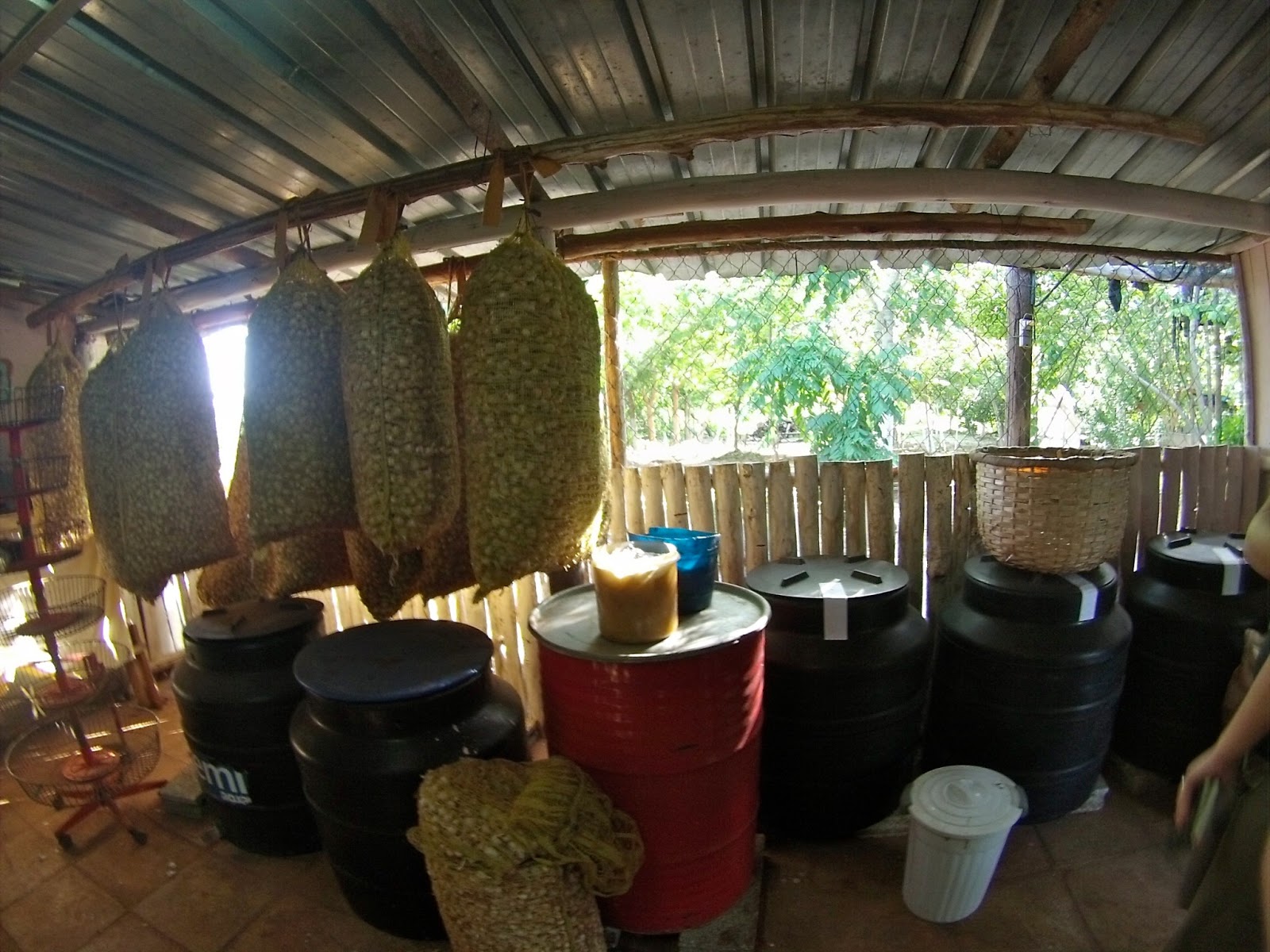
The atmosphere in the department could not have been lighter hearted. While filling bags of Humus de lombriz, or while peeling garlic there was plenty of time to talk, joke and exchange swear words. Unfortunately since we only worked in the agroindustria department for a week we couldn't see all the different things they make. To do that I think you'd have to work there for a year. We did however fill and bags of Humus de lombiz (nutrient rich soil) that are sold at the front of the organopónico for one Cuban peso a piece, we saw how salsa criollo is made by blending basil, oregano, salt, vinegar, and onion, to create a salsa that is very popular on pastas, we sifted clumps out of the "sazonador" (combination of spices) before it was packaged, and on our final day we peeled more garlic than I can express. Even after showering, the garlic smell is still clinging to both Kat and I. Personally I love the smell of garlic so for the moment I don't mind too much. Below are photos of the department and the lovely people we worked with this week:
The main office on the left, Humus de lombriz on the right.

Mariuska sealing the bags of Humus de lombriz with the "macina sellador" (sealing machine that looks like a giant stapler)


Wall of all the different products they sell

LOTS of garlic, and bins filled with various spices

Luis showing us how the beds where the dry the plants before processing them further

Sazonador before and after going through the sieve 

Sazonador after packaging (Luisa, Mariuska and Koral package these with the macina sellador pictured above) They sell for one cuban peso per package.

Luis making the salsa criollo

Kat and I smashing garlic with wooden blocks (very stress relieving)

So much garlic.

Just so much.

Koral and Mariuska fanning away the garlic peels

Pastas de Ajo (garlic paste that is the end result of our garlic peeling). One and one quarter full bag of garlic will produce 11 bottles like this one which sell for 10 cuban pesos.